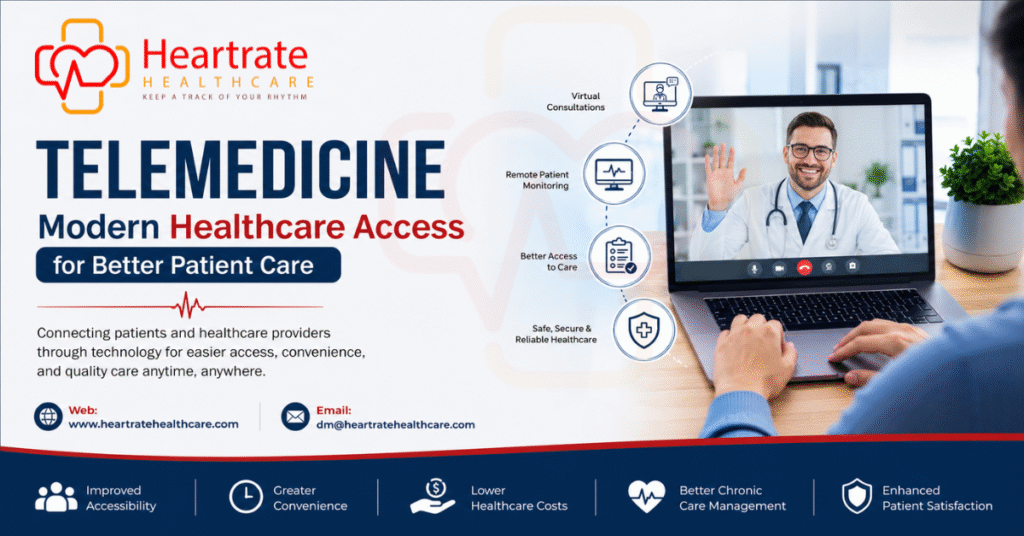

Healthcare is rapidly evolving with the help of digital technology. One of the most significant innovations transforming the medical industry is Telemedicine. It enables patients and healthcare professionals to communicate remotely using secure digital platforms, making healthcare services more accessible, affordable, and efficient.
Whether someone lives in a rural community, has mobility limitations, or simply wants faster access to medical advice, Telemedicine provides a convenient solution. From virtual consultations to remote patient monitoring, this technology is reshaping the future of healthcare around the world.
At Heartrate Healthcare (HRHC), we understand the importance of digital healthcare transformation and support healthcare organizations with reliable healthcare solutions that improve operational efficiency and patient satisfaction.
What Is Telemedicine?
Telemedicine is the use of telecommunications technology to deliver healthcare services remotely. Instead of visiting a clinic or hospital for every consultation, patients can communicate with physicians, specialists, nurses, or other healthcare professionals through video calls, phone calls, or secure messaging platforms.
This approach makes medical services more accessible while reducing unnecessary travel and waiting times.
Healthcare providers use Telemedicine for various purposes, including:
- Routine health consultations
- Follow-up appointments
- Prescription management
- Mental health counseling
- Chronic disease monitoring
- Specialist referrals
- Medical advice
- Patient education
The adoption of Telemedicine has accelerated worldwide as healthcare organizations recognize its ability to improve patient outcomes while reducing healthcare costs.
Why Telemedicine Is Becoming Essential
Modern patients expect convenience in every aspect of their lives, including healthcare. Digital healthcare solutions allow providers to meet these expectations without compromising the quality of care.
Several factors contribute to the growing popularity of Telemedicine, including:
- Increased internet accessibility
- Smartphone adoption
- Secure healthcare platforms
- Rising healthcare costs
- Aging populations
- Demand for convenient healthcare
- Improved remote monitoring devices
- Better patient engagement
As technology continues to improve, Telemedicine is becoming an essential part of modern healthcare systems.
How Telemedicine Works
The Telemedicine process is simple and user-friendly.
Step 1: Appointment Scheduling
Patients schedule appointments through an online healthcare portal or mobile application.
Step 2: Secure Digital Connection
Healthcare providers connect with patients using HIPAA-compliant video conferencing or secure communication systems.
Step 3: Medical Consultation
Doctors evaluate symptoms, review medical history, discuss concerns, and recommend treatment options.
Step 4: Diagnosis and Treatment
Providers may prescribe medications, recommend laboratory tests, or advise in-person examinations when necessary.
Step 5: Follow-Up Care
Patients receive continued care through virtual follow-up appointments without repeatedly traveling to healthcare facilities.
This streamlined workflow significantly improves healthcare accessibility while saving time for both patients and providers.
Types of Telemedicine
Healthcare organizations utilize several forms of Telemedicine, depending on patient needs.
1. Live Video Consultations
Patients communicate directly with healthcare providers through real-time video conferencing.
These appointments closely resemble traditional office visits while offering greater convenience.
2. Store-and-Forward Telemedicine
Medical information such as X-rays, laboratory reports, pathology images, and diagnostic records is securely shared between healthcare professionals for evaluation.
This method is commonly used by specialists.
3. Remote Patient Monitoring
Wearable devices and connected medical equipment continuously monitor patients with chronic illnesses.
Healthcare providers receive health data remotely and intervene when necessary.
4. Mobile Health (mHealth)
Healthcare services are delivered through mobile applications that help patients schedule appointments, receive medication reminders, monitor health metrics, and communicate with healthcare professionals.
Benefits of Telemedicine for Patients
The advantages of Telemedicine continue to expand as healthcare technology improves.
Improved Accessibility
Patients living in remote or underserved communities gain easier access to qualified healthcare professionals.
Greater Convenience
Appointments can be attended from home, eliminating transportation challenges.
Reduced Waiting Time
Virtual consultations often reduce appointment delays.
Lower Healthcare Costs
Patients save money on transportation, childcare, and missed workdays.
Better Chronic Disease Management
Patients with diabetes, hypertension, heart disease, and asthma benefit from regular virtual monitoring.
Enhanced Mental Healthcare
Virtual counseling provides confidential access to licensed mental health professionals.
Better Continuity of Care
Follow-up appointments become easier, increasing treatment compliance and improving health outcomes.
Benefits of Telemedicine for Healthcare Providers
Healthcare organizations also experience significant operational improvements.
Benefits include:
- Better patient engagement
- Increased appointment efficiency
- Reduced no-show rates
- Expanded patient reach
- Lower administrative costs
- Improved workflow automation
- Better documentation
- Higher patient satisfaction
- Increased provider productivity
- Enhanced healthcare accessibility
Organizations partnering with Heartrate Healthcare (HRHC) can further optimize healthcare operations through advanced healthcare support services and digital process improvements.
Relevant Keywords Included Naturally:
- Virtual Healthcare
- Telehealth Services
- Remote Healthcare
- Online Doctor Consultation
- Digital Healthcare
- Remote Patient Monitoring
- Healthcare Technology
- Virtual Medical Care
- Telehealth Platform
- Healthcare Innovation
- Electronic Health Records
- Patient Care
- Healthcare Solutions
- Medical Consultation
- Digital Health Services
Inline Tags:
#Telemedicine #Telehealth #DigitalHealthcare #VirtualHealthcare #HealthcareTechnology #RemotePatientMonitoring #PatientCare #HealthcareInnovation #OnlineDoctor #HealthcareSolutions #HeartrateHealthcare #HRHC
Challenges and Limitations of Telemedicine
Although telemedicine has transformed access to care, it is not a complete replacement for every in-person visit. Some medical situations require hands-on evaluation, diagnostic imaging, laboratory testing, or emergency treatment. A patient with chest pain, severe injury, or sudden neurological symptoms should seek immediate in-person care rather than rely on a virtual appointment.
Technology barriers also remain a concern. Not every patient has a reliable internet connection, a smartphone, or a computer with a camera. Older adults and individuals with limited digital literacy may need extra support to use telehealth services effectively. Healthcare organizations can reduce these barriers by offering simple instructions, multilingual support, and technical assistance before appointments begin.
Another limitation is the lack of physical examination. While many conditions can be assessed through conversation, visual observation, and patient-reported data, some diagnoses still depend on touch, auscultation, or direct testing. For this reason, the most effective telemedicine programs use a hybrid model that combines virtual healthcare with in-person visits when needed.
Security, Privacy, and Compliance in Virtual Care
Because telemedicine involves sensitive medical information, privacy and security must remain top priorities. Healthcare providers should use encrypted communication platforms, secure login systems, and compliant electronic health records to protect patient data. Strong cybersecurity practices help prevent unauthorized access and build trust between patients and providers.
Compliance is equally important. Healthcare organizations must follow applicable regulations, including HIPAA and other regional privacy laws, when delivering digital healthcare services. Staff members should receive regular training on secure communication, proper documentation, and safe handling of patient information. Patients should also be informed about how their data is used, stored, and protected.
When security is handled correctly, telemedicine becomes a dependable and trustworthy part of modern healthcare technology. Patients are more likely to engage with virtual medical care when they know their personal information is protected.
Telemedicine Across Different Medical Specialties
One of the greatest strengths of telemedicine is its flexibility. It can support a wide range of specialties and care settings.
In primary care, online doctor consultation helps patients discuss common illnesses, medication refills, preventive care, and follow-up questions without leaving home. This improves convenience and encourages patients to seek care earlier.
In mental health, telehealth services have become especially valuable. Virtual counseling and psychiatric appointments allow patients to speak with licensed professionals in a private and comfortable environment. For many people, this reduces stigma and makes treatment easier to access.
Dermatology also benefits from remote healthcare. Patients can share images of skin conditions, allowing specialists to review rashes, acne, infections, or suspicious lesions before recommending treatment or an in-person examination.
Cardiology and endocrinology use remote patient monitoring to track vital signs, blood pressure, glucose levels, and other important health indicators. These data-driven visits help providers manage chronic conditions more effectively.
Pediatrics, women’s health, rehabilitation, and post-surgical follow-up care can also be supported through virtual medical care. As technology improves, more specialties are finding practical ways to integrate telemedicine into everyday practice.
The Importance of Remote Patient Monitoring
Remote patient monitoring is one of the most powerful applications of telemedicine. It allows healthcare providers to track patient health data in real time using connected devices and wearable technology. Blood pressure cuffs, glucose monitors, pulse oximeters, and heart rate trackers can send information directly to care teams.
This continuous flow of data helps providers identify changes early, before they become serious problems. For patients with chronic illnesses, remote monitoring can reduce hospital visits, improve medication adherence, and support better long-term outcomes. It also gives patients a greater sense of control over their own health.
Remote patient monitoring is especially useful for older adults, patients recovering from surgery, and individuals with conditions that require frequent observation. By combining digital health services with proactive care management, healthcare organizations can improve quality while reducing unnecessary costs.
How Heartrate Healthcare (HRHC) Supports Telemedicine Adoption
At Heartrate Healthcare (HRHC), we recognize that successful telemedicine programs require more than just technology. They also need efficient workflows, trained staff, accurate documentation, and strong patient communication. HRHC helps healthcare organizations build systems that support these goals.
Our healthcare solutions are designed to improve operational efficiency while enhancing the patient experience. We assist with digital healthcare processes, administrative support, and care coordination so providers can focus more time on patient care. By streamlining scheduling, communication, and documentation, HRHC helps organizations make virtual healthcare more effective and scalable.
We also understand the importance of integrating telemedicine with electronic health records and other healthcare technology platforms. When systems work together smoothly, providers can access patient information quickly, reduce errors, and deliver more personalized care.
For organizations looking to expand telehealth services, HRHC can provide the support needed to create a reliable and patient-centered virtual care model.
Best Practices for Successful Telemedicine Programs
Healthcare organizations can improve telemedicine outcomes by following a few important best practices.
First, choose a secure and user-friendly telehealth platform. Patients and providers should be able to connect easily without technical confusion.
Second, train staff thoroughly. Physicians, nurses, administrative teams, and support personnel should understand how to use the technology, document visits correctly, and communicate clearly with patients.
Third, educate patients before their appointments. Simple instructions about logging in, testing audio and video, and preparing medical questions can make virtual visits more productive.
Fourth, determine which types of visits are appropriate for telemedicine and which require in-person care. A clear triage process helps ensure patient safety.
Fifth, integrate telemedicine with electronic health records and billing systems. This improves continuity of care and reduces administrative burden.
Finally, collect feedback from patients and staff. Regular evaluation helps organizations identify problems, improve workflows, and strengthen the overall virtual care experience.
Telemedicine and Healthcare Equity
Telemedicine can play an important role in reducing healthcare disparities when it is implemented thoughtfully. Patients in rural areas, individuals with transportation challenges, and people with limited mobility often struggle to reach traditional healthcare facilities. Virtual care removes many of these obstacles and gives more people access to timely medical advice.
However, equity depends on more than availability. Healthcare organizations must also consider language access, disability accommodations, and digital literacy. Offering multilingual support, captioning, accessible interfaces, and patient education can make telehealth services more inclusive. Community outreach and device assistance programs can also help patients who might otherwise be left behind.
When healthcare systems design telemedicine with equity in mind, they create a more inclusive model of care that serves diverse populations more effectively.
How Patients Can Prepare for a Virtual Visit
Patients can get more value from telemedicine by preparing in advance. Before the appointment, they should review symptoms, gather medication lists, and note any questions they want to ask. Testing the internet connection, camera, and microphone ahead of time can prevent delays. It is also helpful to choose a quiet, private space with good lighting so the provider can observe symptoms clearly and the conversation remains confidential.
If the visit involves remote patient monitoring, patients should have their devices ready and know how to share readings. They should also keep a record of recent health changes, such as pain levels, sleep patterns, blood pressure, or blood sugar trends. This information helps the provider make better decisions during the consultation.
Prepared patients often experience smoother appointments and better outcomes. When both sides are ready, telemedicine becomes a highly efficient form of virtual medical care.
The Future of Telemedicine
The future of telemedicine looks promising as healthcare technology continues to advance. Artificial intelligence, predictive analytics, wearable devices, and faster internet connections are making remote healthcare more intelligent and responsive.
AI-powered tools may help providers analyze symptoms, prioritize urgent cases, and personalize treatment recommendations. Virtual reality and augmented reality could support medical training, rehabilitation, and patient education. As 5G networks expand, video quality and data transmission will improve, making online doctor consultation even more seamless.
In the coming years, telemedicine will likely become a standard part of hybrid healthcare models. Patients will move between virtual and in-person care depending on their needs, while providers will use digital health services to maintain continuity and improve outcomes. This blended approach offers the flexibility, efficiency, and accessibility that modern healthcare demands.
Conclusion
Telemedicine has become one of the most important innovations in modern healthcare. By connecting patients and providers through secure digital platforms, it improves access, reduces barriers, and supports better care for a wide range of conditions. From virtual healthcare and remote patient monitoring to mental health support and chronic disease management, the benefits are clear.
Although challenges remain, healthcare organizations can overcome them with the right technology, training, and patient support. With trusted partners like Heartrate Healthcare (HRHC), providers can build telehealth services that are efficient, secure, and patient-centered.
As digital healthcare continues to evolve, telemedicine will play an even greater role in shaping the future of patient care. It is not just a temporary solution; it is a lasting advancement that is helping healthcare become more accessible, more responsive, and more effective for everyone.