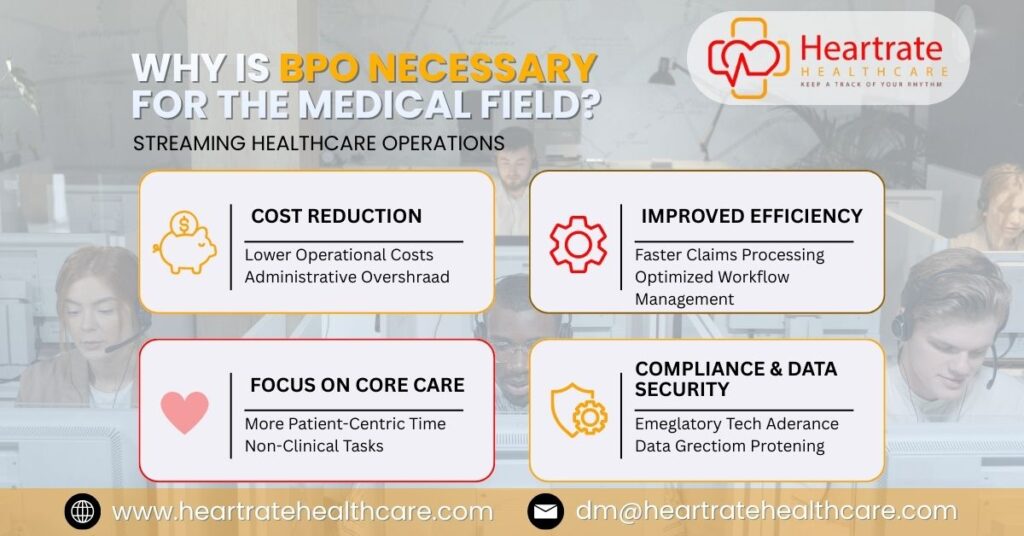

Why Is BPO Necessary for the Medical Field?
The healthcare industry is growing rapidly across the globe. Hospitals, clinics, and private practices are facing increasing administrative pressure, strict regulations, and rising operational costs. In this environment, many healthcare providers are asking one important question: Why is BPO necessary for the medical field?
Business Process Outsourcing (BPO) has become a strategic solution that allows healthcare organizations to focus on patient care while experts handle administrative and operational tasks. Companies like Heartrate Healthcare (HRHC) provide specialized medical BPO services designed to improve efficiency, ensure compliance, and increase revenue.
Let’s explore why BPO is not just helpful—but essential—for the modern medical field.
1. Reduces Administrative Burden
Healthcare professionals are trained to treat patients, not manage paperwork. However, hospitals and clinics deal with large volumes of administrative tasks such as:
Medical billing and coding
Insurance verification
Claims submission
Appointment scheduling
Patient data entry
Revenue cycle management
These processes are time-consuming and require specialized expertise. By outsourcing to a trusted BPO provider like Heartrate Healthcare (HRHC), medical facilities can reduce administrative stress and allow doctors and staff to focus on delivering quality care.
2. Improves Revenue Cycle Management (RCM)
Revenue cycle management is critical for financial stability in healthcare. Errors in billing or coding can lead to:
Claim denials
Delayed payments
Revenue loss
Compliance penalties
One major reason Why is BPO necessary for the medical field? is to ensure accurate and efficient RCM. Professional BPO teams use trained medical coders and billing specialists who understand international healthcare standards such as ICD-10 and CPT coding systems.
With proper revenue cycle management:
Claims are processed faster
Denials are reduced
Cash flow improves
Financial transparency increases
This directly impacts the profitability and sustainability of healthcare organizations.
3. Ensures Regulatory Compliance
Healthcare is one of the most regulated industries worldwide. Medical organizations must comply with various data privacy and healthcare regulations depending on their country, including:
HIPAA (USA)
GDPR (Europe)
Local health authority guidelines
Non-compliance can result in legal issues and financial penalties. A professional BPO partner ensures:
Secure patient data handling
Regular compliance updates
Proper documentation
Standardized workflows
This is another strong answer to Why is BPO necessary for the medical field? Compliance is complex, and outsourcing reduces risks significantly.
4. Cost Efficiency and Operational Savings
Hiring in-house billing, coding, and administrative staff can be expensive. Costs include:
Salaries
Training
Infrastructure
Software
Employee benefits
Outsourcing medical processes to Heartrate Healthcare (HRHC) helps reduce these expenses without compromising quality. BPO companies already have:
Skilled professionals
Updated software systems
Established workflows
Quality control teams
This makes BPO a cost-effective solution for small clinics and large hospitals alike.
5. Access to Skilled Medical Experts
Medical billing and coding require specialized training. Mistakes can lead to compliance issues and financial losses. When healthcare providers outsource, they gain access to:
Certified medical coders
RCM experts
Insurance specialists
Data management professionals
Instead of investing time and money in recruiting and training staff, medical organizations can rely on experienced BPO professionals who deliver accurate results from day one.
This expertise is a key reason Why is BPO necessary for the medical field? It ensures professional handling of complex processes.
6. Enhances Patient Experience
Patient satisfaction is directly linked to efficient back-end operations. Billing errors, insurance delays, or scheduling issues can frustrate patients.
With streamlined BPO support:
Appointments are scheduled smoothly
Billing queries are resolved quickly
Insurance approvals are processed faster
Communication improves
When administrative processes run efficiently, patients receive a better overall healthcare experience.
7. Scalability and Flexibility
Healthcare demand fluctuates. During peak seasons or public health emergencies, administrative workloads increase dramatically.
A BPO partner offers scalable solutions:
Increase staff during high volume periods
Reduce workload during slow seasons
Adapt quickly to new regulations
Instead of hiring and firing staff frequently, outsourcing provides flexible solutions that match your operational needs.
This flexibility clearly answers the question: Why is BPO necessary for the medical field? Because healthcare is unpredictable, and scalable support is essential.
8. Focus on Core Medical Services
Doctors, nurses, and medical staff should focus on patient treatment and clinical excellence—not paperwork.
By outsourcing non-core tasks to Heartrate Healthcare (HRHC), healthcare providers can:
Improve clinical productivity
Reduce burnout among staff
Increase patient consultation time
Enhance overall service quality
When core and non-core functions are clearly separated, healthcare organizations operate more efficiently.
9. Advanced Technology and Automation
Modern BPO providers use advanced healthcare technology such as:
Electronic Health Records (EHR) integration
Automated billing systems
AI-powered claims analysis
Data analytics for performance tracking
Small and mid-sized clinics may not afford these technologies independently. Partnering with an experienced BPO company gives access to advanced tools without large investments.
Technology integration further explains Why is BPO necessary for the medical field? It drives innovation without increasing costs.
10. International Support and Global Standards
Healthcare providers serving international patients need standardized processes. A professional BPO partner ensures:
Global billing standards
Multilingual communication support
Time-zone flexibility
International compliance understanding
Heartrate Healthcare (HRHC) offers services designed to meet global healthcare demands, helping medical organizations expand their reach internationally.
Why Choose Heartrate Healthcare (HRHC)?
Heartrate Healthcare (HRHC) specializes in medical BPO services that help healthcare providers:
Increase revenue
Reduce claim denials
Improve operational efficiency
Maintain data security
Ensure regulatory compliance
With a commitment to quality, transparency, and performance tracking, HRHC supports hospitals, clinics, and healthcare practices worldwide.
Final Thoughts
So, Why is BPO necessary for the medical field?
Because healthcare today requires more than just medical expertise. It demands financial accuracy, regulatory compliance, operational efficiency, and technological advancement. BPO bridges the gap between clinical care and administrative excellence.
Outsourcing to a reliable partner like Heartrate Healthcare (HRHC) allows healthcare providers to:
Focus on patients
Improve profitability
Enhance efficiency
Reduce risks
Scale confidently
In a competitive global healthcare market, BPO is no longer optional—it is a strategic necessity.